Ship manoeuvring is one of the most critical aspects of maritime navigation, involving the controlled movement of a vessel in restricted waters, ports, channels, and open seas. It is not just about steering a ship from one point to another, but about precision control, situational awareness, and understanding how environmental forces like wind, current, and tide affect vessel behaviour. In professional maritime training, ship manoeuvring is considered a core competency for deck officers and marine professionals because even small errors can lead to costly or dangerous situations.
In practical terms, manoeuvring of ship includes actions such as turning, stopping, docking, undocking, and navigating through congested traffic areas. Modern shipping demands high-level expertise in ship handling and manoeuvring, especially as vessels become larger and ports more complex.
Today, maritime academies place strong emphasis on simulation-based learning, where trainees can experience real-world scenarios without actual risk. This is where tools like a ship manoeuvring simulator become extremely valuable for skill development.
What is Ship Manoeuvring and Why is it Important?
The term ship manoeuvring refers to the process of controlling a vessel’s movement using propulsion systems, rudders, thrusters, and external assistance like tugs. Unlike straight-line navigation in open waters, manoeuvring requires constant adjustment and decision-making.
In real operations, manoeuvring ship handling becomes especially important during port entry and exit, collision avoidance, and emergency situations. Officers must understand hydrodynamic effects such as squat, bank effect, and interaction between vessels.
A well-trained officer in vessel manoeuvring can safely guide even ultra-large container ships through narrow channels with precision. This skill is not only technical but also highly situational, relying on experience, anticipation, and calm judgment.
Manoeuvring in Ship: Core Principles Every Mariner Must Know
The concept of manoeuvring in ship revolves around understanding how a vessel responds to helm and engine inputs under varying conditions. Every ship behaves differently depending on its size, hull form, load condition, and propulsion system.
For example, a fully loaded tanker behaves very differently from a ballast condition vessel. Similarly, windage area plays a major role in manoeuvring response, especially for container ships with high deck stacks.
To master manoeuvring of ship, seafarers must understand:
- How turning circles vary with speed and rudder angle
- How stopping distances change with displacement
- How environmental forces influence drift and set
- How propulsion delay impacts real-time decision-making
These principles are usually practiced extensively in controlled environments before being applied onboard.
Ship Handling and Manoeuvring in Real Maritime Scenarios
Ship handling and manoeuvring is not just theoretical knowledge; it is a practical skill developed through repetition and experience. Every port call presents unique challenges such as narrow berths, strong currents, and traffic density.
In real-world navigation, officers must constantly interpret multiple inputs such as radar, ECDIS, visual bearings, and engine performance feedback. A slight miscalculation during docking can result in structural damage or operational delays.
This is why maritime institutions increasingly focus on simulation-based training, where trainees can practice vessel manoeuvring under realistic conditions. The ability to respond to sudden changes like engine failure or unexpected wind gusts is a key outcome of such training.
Role of Ship Manoeuvring Simulator in Maritime Training
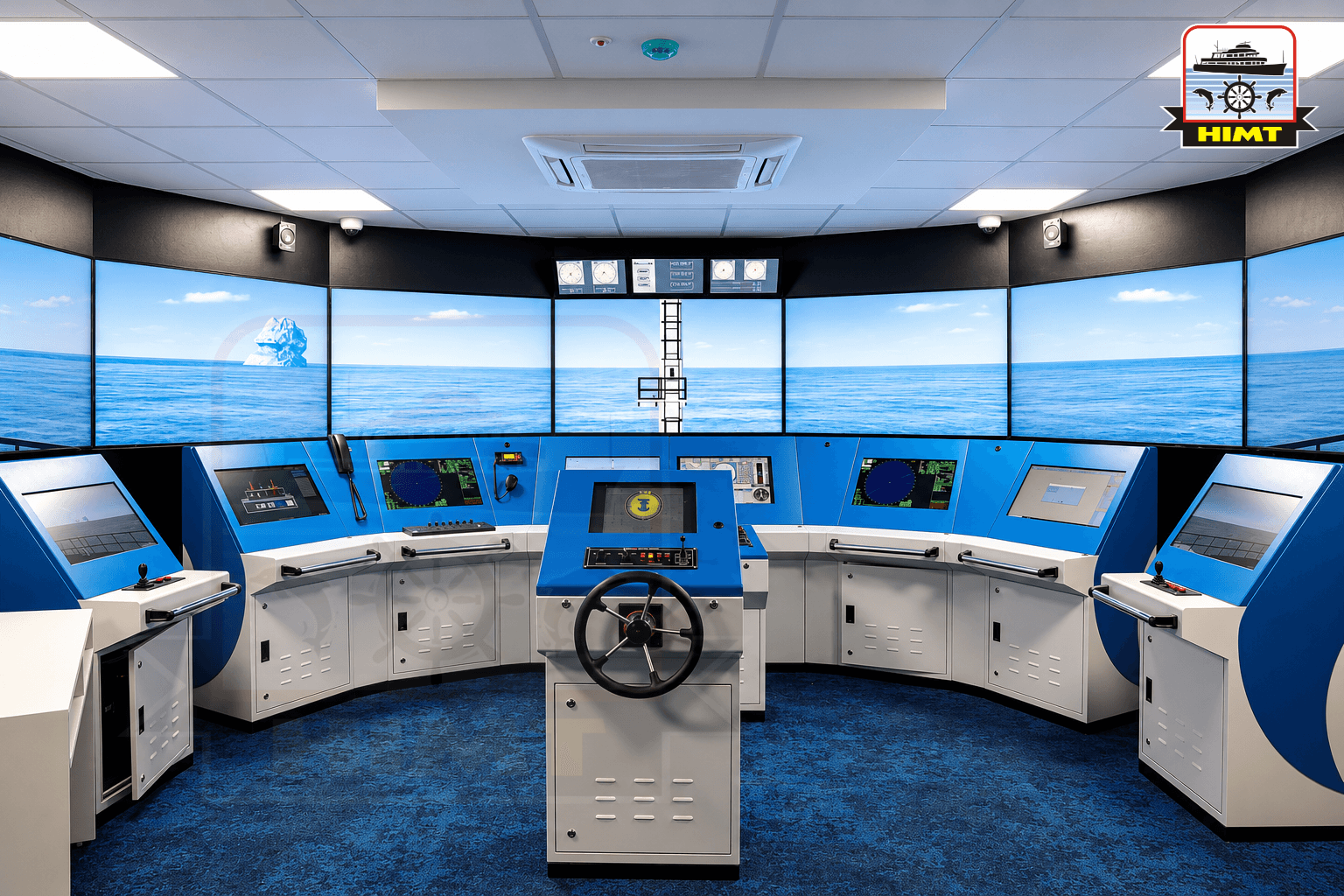
A ship manoeuvring simulator is an advanced training system that replicates real ship behaviour using computer-generated environments and physics-based models. It allows trainees to experience complex navigational scenarios without risk to life or property.
These simulators are widely used for developing competence in ship manoeuvring in India, where maritime training standards are aligned with international requirements like STCW. Trainees can practice docking, undocking, collision avoidance, and emergency response in a controlled setup.
The biggest advantage of simulation training is repetition. Officers can repeat the same scenario multiple times until they develop confidence and precision in decision-making.
At training institutes like HIMT College, simulation-based programs are structured to closely replicate real bridge environments, ensuring that trainees transition smoothly from classroom learning to onboard operations.
Ship Manoeuvring in India: Growing Demand for Skilled Officers
The maritime industry in India has seen rapid growth, increasing the demand for highly skilled navigators who understand advanced ship maneuvering techniques. With expanding port infrastructure and larger vessels calling at Indian ports, the need for professional manoeuvring ship handling expertise has never been greater.
Indian maritime training institutions have responded by integrating simulator-based learning into their curriculum. This ensures that officers are exposed to complex navigational challenges even before stepping onboard.
The focus is not only on theoretical understanding but also on practical exposure to real-life scenarios such as congested port approaches, emergency manoeuvres, and heavy weather navigation.
Advanced Concepts in Vessel Manoeuvring
Advanced vessel manoeuvring goes beyond basic steering and includes understanding ship dynamics under extreme conditions. Officers must be able to anticipate how a ship reacts to delayed engine response, shallow water effects, and interaction with other vessels.
In addition, modern vessels equipped with azimuth thrusters, bow thrusters, and dynamic positioning systems require specialized knowledge. Understanding how to combine these systems effectively is essential for safe ship handling and manoeuvring.
Simulation-based training plays a critical role in helping officers build this advanced understanding without real-world risks.
What is Advanced Ship Manoeuvring?
Advanced ship manoeuvring refers to the higher-level control and decision-making involved in operating a vessel under complex and high-risk conditions. This includes navigating through congested waterways, performing precision docking in adverse weather, handling propulsion failures, and executing emergency turns to avoid collisions.
Unlike basic manoeuvring, advanced techniques require deep understanding of hydrodynamics, ship response behaviour, and environmental forces. It also involves coordination between bridge teams, engine control, and external support like tugboats.
Advanced manoeuvring skills are typically developed through structured simulation training and real-world onboard experience.
Advanced Simulator Training for Ship Manoeuvring in India
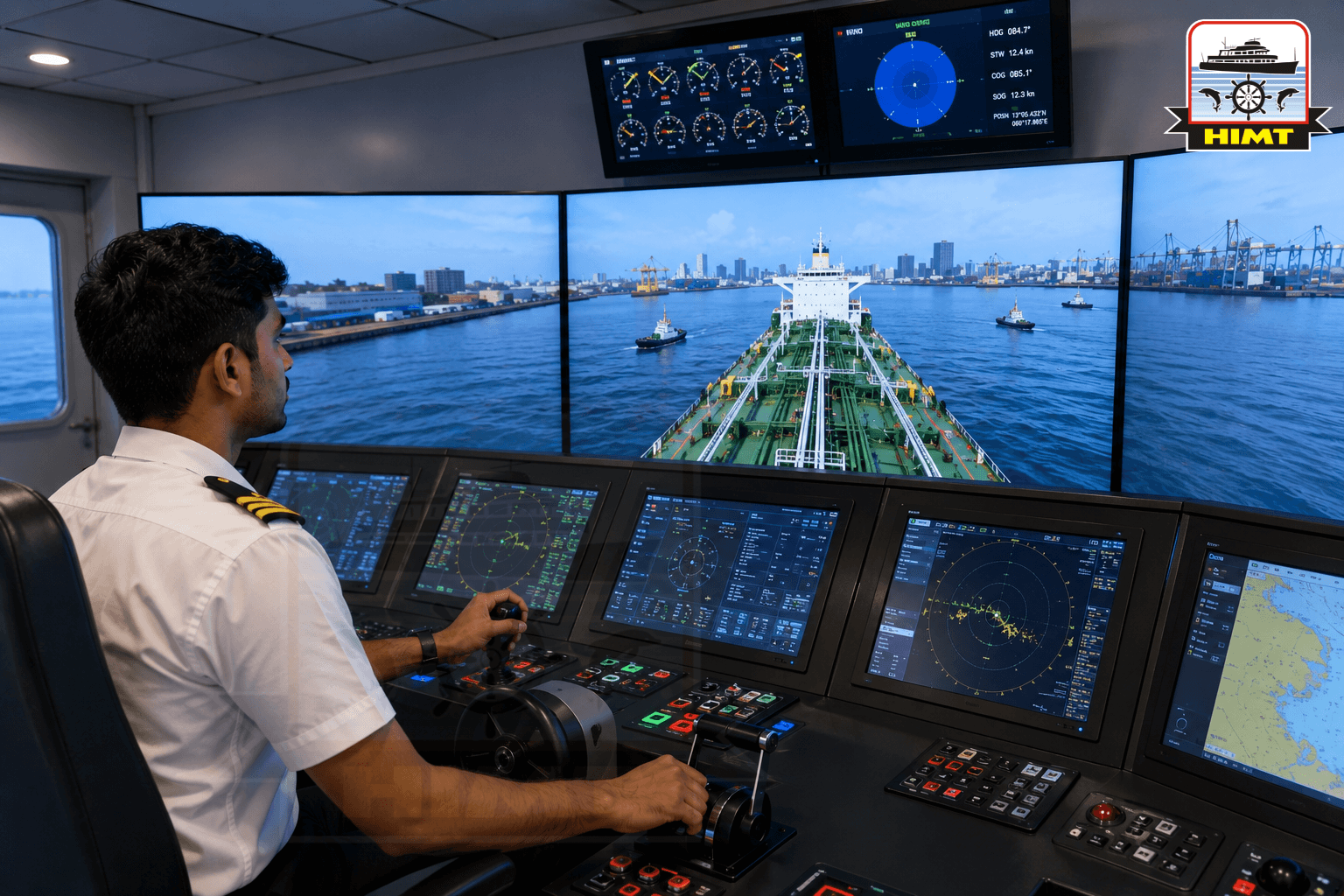
Advanced simulator training for ship manoeuvring in India is offered by specialized maritime training institutes that focus on bridge simulation and practical navigation skills. One such structured program is the Ship Manoeuvring Simulator (SMS) course conducted by HIMT.
This is a 5-day simulator-based training program conducted every month at Kilpauk and Tidal Park locations. The course is designed to give trainees hands-on exposure to realistic ship handling scenarios using advanced simulation systems.
During this training, participants practice critical operations such as port entry, channel navigation, emergency stopping, and collision avoidance under various environmental conditions. The focus is on improving decision-making speed and accuracy in real-time situations.
Key Learning Outcomes of Ship Manoeuvring Training
While learning ship manoeuvring, trainees develop a combination of technical and cognitive skills that are essential for safe navigation. The training is structured to build confidence and reduce human error in real operations.
Some of the major learning outcomes include:
- Improved understanding of ship response characteristics under different loads
- Enhanced ability to interpret environmental effects like wind and current
- Better coordination during bridge teamwork and communication
- Stronger decision-making skills in emergency scenarios
These outcomes directly contribute to safer and more efficient vessel operations worldwide.
Why Simulation is the Future of Ship Handling and Manoeuvring
Modern maritime training is shifting heavily toward simulation because it provides a safe yet realistic environment for learning ship handling and manoeuvring. Unlike traditional classroom-based learning, simulators allow trainees to experience unpredictable scenarios that cannot be easily demonstrated in real life.
For example, sudden engine failure during docking or unexpected crosswind in a narrow channel can be simulated repeatedly until the trainee learns the correct response. This builds muscle memory and improves reaction time in real operations.
As global shipping becomes more complex, simulation-based ship manoeuvring simulator training is becoming an essential part of maritime education.
Conclusion: Mastering Vessel Manoeuvring for a Safer Maritime Future
Mastering ship manoeuvring is essential for every maritime professional aiming to operate safely and efficiently in today’s demanding shipping environment. From basic steering to advance vessel manoeuvring in challenging conditions, the skill requires continuous learning, practice, and exposure.
With increasing reliance on technology and simulation, modern training methods are transforming how officers learn manoeuvring in ship operations. HIMT is playing a key role in bridging the gap between theoretical knowledge and real-world application through programs like the Ship Manoeuvring Simulator (SMS).
As the shipping industry continues to evolve, professionals equipped with strong ship handling and manoeuvring skills will remain at the forefront of safe and efficient maritime operations worldwide.
FAQs
1. What is ship manoeuvring and why is it important in shipping?
Ship manoeuvring is the controlled movement of a vessel in ports, narrow channels, and open waters. It is crucial for safe navigation, collision avoidance, and efficient port operations, especially in congested maritime routes.
2. What skills are required for ship handling and manoeuvring?
Strong situational awareness, understanding of wind and current effects, engine response knowledge, and teamwork on the bridge are essential. Officers must also be skilled in decision-making under pressure.
3. What is the use of a ship manoeuvring simulator?
A ship maneuvering simulator allows trainees to practice real-life navigation scenarios in a safe virtual environment. It helps improve confidence in docking, undocking, and emergency handling without real-world risks.
4. Is ship manoeuvring difficult to learn for beginners?
It can be challenging initially because it involves understanding ship dynamics and environmental effects. However, with simulator training and practice, learners gradually develop strong control and confidence.
5. What is the best training for advanced ship manoeuvring in India?
Advanced training is offered through simulator-based courses like the Ship Manoeuvring Simulator (SMS) at HIMT. It provides hands-on practice in realistic navigation scenarios to build professional-level skills.