Fire is one of the most dangerous emergencies that can occur at sea. Unlike on land, a ship operates in an isolated environment where immediate external assistance is often unavailable. A small fire can rapidly escalate into a life-threatening incident, endangering crew members, cargo, the marine environment, and the vessel itself. This is why Fire Fighting Safety Courses are among the most important mandatory training programs for seafarers worldwide.
Every maritime professional, whether joining a ship for the first time or serving in a senior rank, must possess the knowledge and practical skills to prevent, control, and extinguish onboard fires. International regulations under the Standards of Training, Certification and Watchkeeping (STCW) Convention require seafarers to undergo specialized fire fighting training before serving onboard ships.
In India, fire fighting training for merchant navy professionals is primarily delivered through three DGMA / DG Shipping approved STCW courses:
- Basic STCW Safety Training (BST)
- Advanced Fire Fighting (AFF)
- Refresher Training for Advanced Training in Fire Fighting (RAFF)
This guide explains why fire fighting training is critical in the maritime industry, how shipboard fires occur, what trainees learn during these courses, and the importance of periodic refresher training.
Why Fire Fighting Training is Essential in the Maritime Industry
Ships carry combustible materials, fuel, lubricants, electrical systems, hydraulic equipment, machinery, chemicals, and cargo that may pose fire hazards. Since vessels operate far from shore, crews must be fully prepared to respond immediately without relying on external emergency services.
Unlike land-based fire incidents, shipboard fires present unique challenges such as:
- Limited escape routes
- Confined engine rooms
- High temperatures
- Toxic smoke
- Restricted ventilation
- Risk of explosion
- Continuous vessel movement due to sea conditions
These factors make proper fire prevention, early detection, and effective firefighting skills essential for every seafarer.
Well-trained crew members can significantly reduce damage, protect lives, and improve the chances of safely controlling an onboard emergency before it becomes catastrophic.
Common Causes of Fire on Ships
Understanding how fires start is the first step toward preventing them. Shipboard fires may result from various operational and technical reasons.
Some of the most common causes include:
- Electrical short circuits
- Fuel or oil leakage
- Engine room overheating
- Galley cooking accidents
- Welding and hot work
- Improper storage of flammable materials
- Cargo-related chemical reactions
- Smoking in restricted areas
- Mechanical equipment failure
- Human error and negligence
Modern vessels implement strict fire prevention procedures, but crew awareness remains the strongest defense against onboard fire emergencies.
Understanding the Fire Triangle
Every seafarer learns one of the most fundamental concepts in fire science, the Fire Triangle.
Fire requires three essential elements:
- Heat
- Fuel
- Oxygen
Removing any one of these three components will extinguish the fire.
During maritime fire fighting training, trainees also learn about the Fire Tetrahedron, which introduces the chemical chain reaction involved in combustion. This knowledge helps seafarers understand why different extinguishing agents work for different types of fires.
Types of Fire on Ships
Different classes of fire require different firefighting techniques and extinguishing agents.
The commonly encountered fire classes include:
- Class A: Solid combustible materials such as wood, paper, cloth, and plastics
- Class B: Flammable liquids including diesel, fuel oil, lubricants, and paints
- Class C: Flammable gases
- Class D: Combustible metals
- Electrical Fires: Energized electrical equipment
- Cooking Oil Fires: Galley fires involving cooking oils and fats
Using the wrong extinguisher can worsen a fire, making proper training extremely important.
Fire Fighting Equipment Used on Merchant Ships
Modern merchant vessels are equipped with advanced fire protection systems designed to detect and suppress fires quickly.
Common fire fighting equipment includes:
- Portable fire extinguishers
- Fire hydrants
- Fire hoses
- Fire nozzles
- Fireman’s outfit
- Self-Contained Breathing Apparatus (SCBA)
- Fire blankets
- Fixed CO₂ fire extinguishing systems
- Foam fire fighting systems
- Water mist systems
- Fire detection and alarm systems
- Emergency escape breathing devices (EEBD)
Training enables crew members to operate this equipment confidently during real emergencies.
1. Basic STCW Safety Training (BST) – 11 Days Course
The Basic STCW Safety Training (BST) course is the mandatory entry-level safety training required for all aspiring seafarers before joining a merchant ship. The course comprises four mandatory modules: Personal Survival Techniques (PST), Fire Prevention and Fire Fighting (FPFF), Elementary First Aid (EFA), and Personal Safety and Social Responsibilities (PSSR).
The course complies with the STCW Convention and prepares candidates to respond effectively to common onboard emergencies, including fire incidents.
Fire Prevention and Fire Fighting (FPFF) is one of the core modules of the BST course. It introduces trainees to the fundamentals of fire prevention, fire detection, and emergency response, equipping them with the essential knowledge and practical skills needed to handle onboard fire emergencies safely and effectively.
During the fire prevention and fire fighting module, participants typically learn:
- Principles of combustion
- Fire hazards onboard ships
- Fire prevention methods
- Fire detection systems
- Types of fire extinguishers
- Portable fire fighting equipment
- Safe evacuation procedures
- Personal protective equipment
- Practical fire fighting exercises
- Team coordination during emergencies
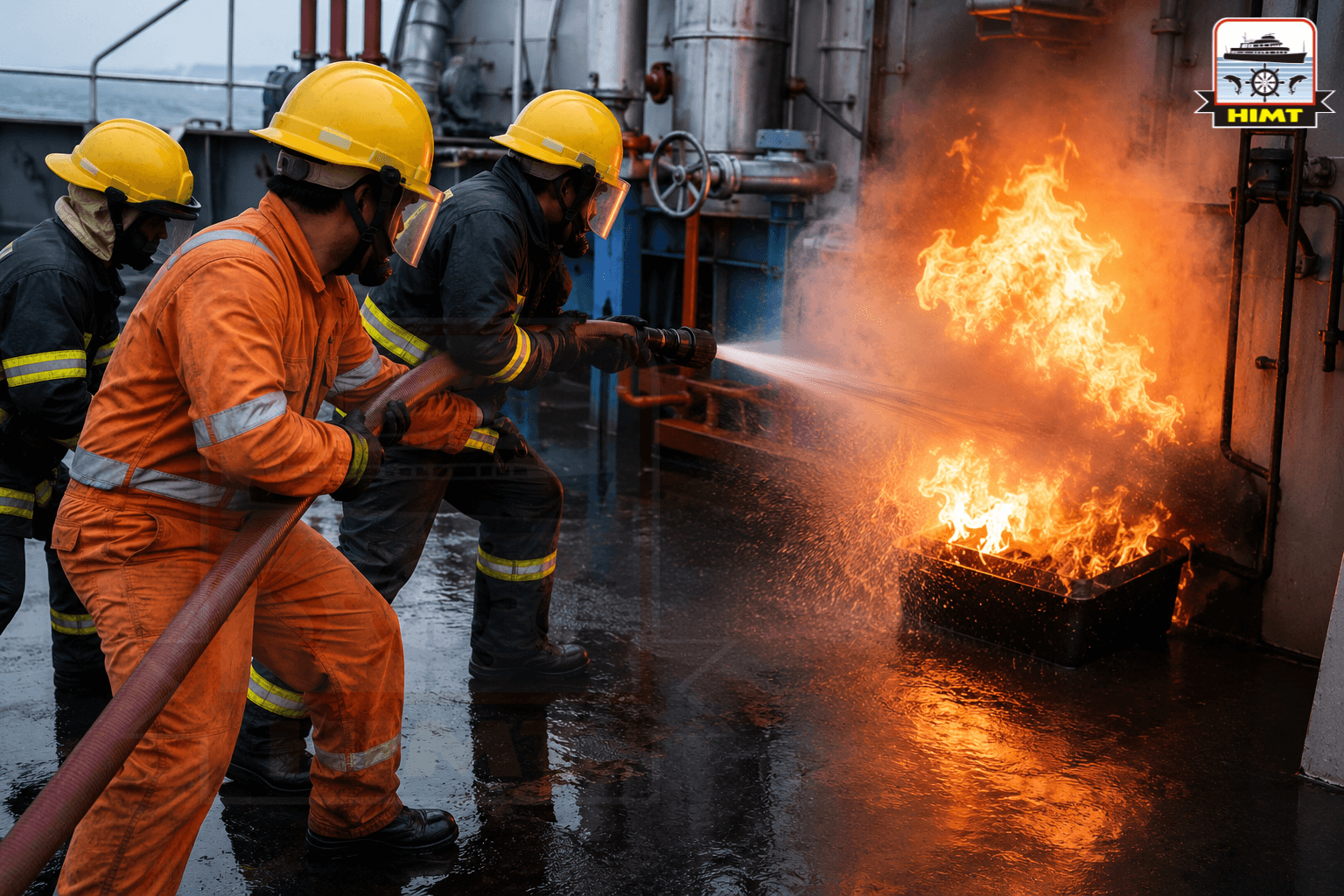
Practical training usually involves extinguishing controlled fires using various extinguishing agents while wearing protective equipment.
BST provides the foundation upon which advanced maritime safety training is built.
2. Advanced Fire Fighting (AFF) – 5 Days Course
The Advanced Fire Fighting (AFF) course is intended for officers and senior crew members who are responsible for managing fire emergencies onboard ships.
Unlike BST, which focuses on basic fire response, AFF develops leadership, command, and tactical decision-making skills required during major shipboard fire incidents.
Participants gain an in-depth understanding of fire dynamics and learn how to organize and lead firefighting teams during complex emergencies.
Topics generally covered include:
- Fire command and control
- Shipboard emergency organization
- Fire risk assessment
- Fire investigation techniques
- Fire prevention management
- Incident planning
- Leadership during emergencies
- Fixed fire suppression systems
- Ventilation control
- Boundary cooling
- Search and rescue in smoke-filled spaces
- Casualty evacuation
- Communication during emergencies
Practical exercises often simulate realistic shipboard fire scenarios where trainees lead teams, coordinate responses, and make operational decisions under pressure.
AFF is particularly important for deck officers, engineering officers, and personnel assigned fire command responsibilities onboard.
3. Refresher Training for Advanced Training in Fire Fighting (RAFF) – 1 Day Course
Maritime safety standards continue to evolve, and practical skills can decline if not regularly practiced. For this reason, STCW requires periodic refresher training for certain safety competencies.
The Refresher Training for Advanced Training in Fire Fighting (RAFF) course helps experienced seafarers maintain competency in advanced firefighting techniques and emergency management.
This course often includes Refresher Proficiency in Fire Prevention and Fire Fighting (RFPFF) components to ensure continued compliance with current STCW requirements.
RAFF focuses on refreshing practical skills while reinforcing updated safety procedures.
Training generally includes:
- Fire command refresher
- Emergency leadership
- Practical fire fighting drills
- SCBA operation
- Fireman’s outfit usage
- Rescue techniques
- Communication during emergencies
- Updated STCW safety requirements
- Review of fire suppression systems
- Realistic emergency simulations
Regular refresher training ensures that experienced officers remain fully prepared to handle emergencies efficiently and safely.
Practical Fire Fighting Drills
Fire fighting competence cannot be developed through classroom learning alone. Practical exercises form a major part of maritime fire fighting training.
Training sessions commonly include:
- Live fire exercises
- Smoke chamber training
- Search and rescue operations
- Fire hose handling
- Portable extinguisher operation
- SCBA wearing procedures
- Team communication drills
- Emergency evacuation practice
These realistic simulations prepare seafarers to remain calm and respond effectively during actual emergencies at sea.
International Standards Governing Maritime Fire Fighting Training
Fire fighting courses are conducted in accordance with internationally recognized maritime safety regulations.
The primary governing standards include:
- STCW Convention and Code
- International Maritime Organization (IMO) guidelines
- SOLAS (Safety of Life at Sea) Convention
- Directorate General of Maritime Administration / Directorate General of Shipping (DG Shipping), Government of India requirements
These regulations establish uniform global competency standards, ensuring that certified seafarers possess the knowledge and practical skills required to serve safely on merchant vessels worldwide.
Career Importance of Fire Fighting Certification
Fire fighting certification is not simply a regulatory requirement; it is a fundamental professional competency.
Proper fire fighting training helps seafarers:
- Improve onboard safety awareness
- Respond confidently during emergencies
- Protect lives and property
- Meet international STCW compliance
- Maintain professional competency
- Enhance career progression opportunities
- Qualify for officer-level responsibilities
Employers also place significant importance on candidates who demonstrate strong safety knowledge and emergency response capabilities.
Conclusion
Fire safety is one of the pillars of maritime operations. Every ship, regardless of its size or trade route, faces potential fire risks that demand immediate, coordinated, and skilled action from its crew. Since external assistance is often hours or even days away, a vessel’s safety depends largely on the preparedness and competence of its seafarers.
The Basic STCW Safety Training (BST) course equips newcomers with essential fire prevention and firefighting skills, forming the foundation of maritime safety. The Advanced Fire Fighting (AFF) course builds on this knowledge by preparing officers and senior crew to lead firefighting operations, manage emergencies, and make critical decisions under pressure. To ensure these skills remain current and effective, the Refresher Training for Advanced Training in Fire Fighting (RAFF) reinforces practical competence, leadership, and compliance with evolving international safety standards.
Collectively, these STCW-approved courses help create a safety-first culture onboard merchant ships, reducing the likelihood of fire-related incidents and improving emergency preparedness across the global shipping industry. Whether beginning a maritime career or advancing into leadership roles, comprehensive fire fighting training remains an indispensable part of every seafarer’s professional development, protecting lives, safeguarding vessels, and supporting safe operations at sea.
FAQs
1. What is the Basic STCW Safety Training (BST) Fire Fighting Course?
The Basic STCW Safety Training (BST) course teaches seafarers the fundamentals of fire prevention, fire detection, and the safe use of firefighting equipment. It is a mandatory STCW course required before joining most merchant ships.
2. Who should take the Advanced Fire Fighting (AFF) course?
The Advanced Fire Fighting (AFF) course is designed for officers and senior crew members responsible for leading firefighting operations onboard. It develops leadership, emergency planning, and advanced fire control skills.
3. Is Refresher Training for Advanced Fire Fighting (RAFF) mandatory?
Yes. RAFF is required under STCW regulations to maintain competency and ensure seafarers remain proficient in advanced firefighting techniques. It helps professionals stay compliant with current maritime safety standards.
4. What practical training is included in maritime fire fighting courses?
Maritime fire fighting courses include live fire drills, SCBA (Self-Contained Breathing Apparatus) training, fire hose handling, search and rescue exercises, smoke chamber drills, and the operation of various firefighting systems used onboard ships.
5. Why is fire fighting training important for merchant navy professionals?
Fire fighting training enables seafarers to prevent, control, and safely extinguish onboard fires, protecting lives, cargo, and the vessel. It also fulfills mandatory STCW certification requirements for working on merchant ships worldwide.