
The Merchant Navy is one of the most exciting and respected career paths for students who dream of working at sea. However, many students get confused between two major departments onboard a ship — the Engine Room and the Ship Bridge.
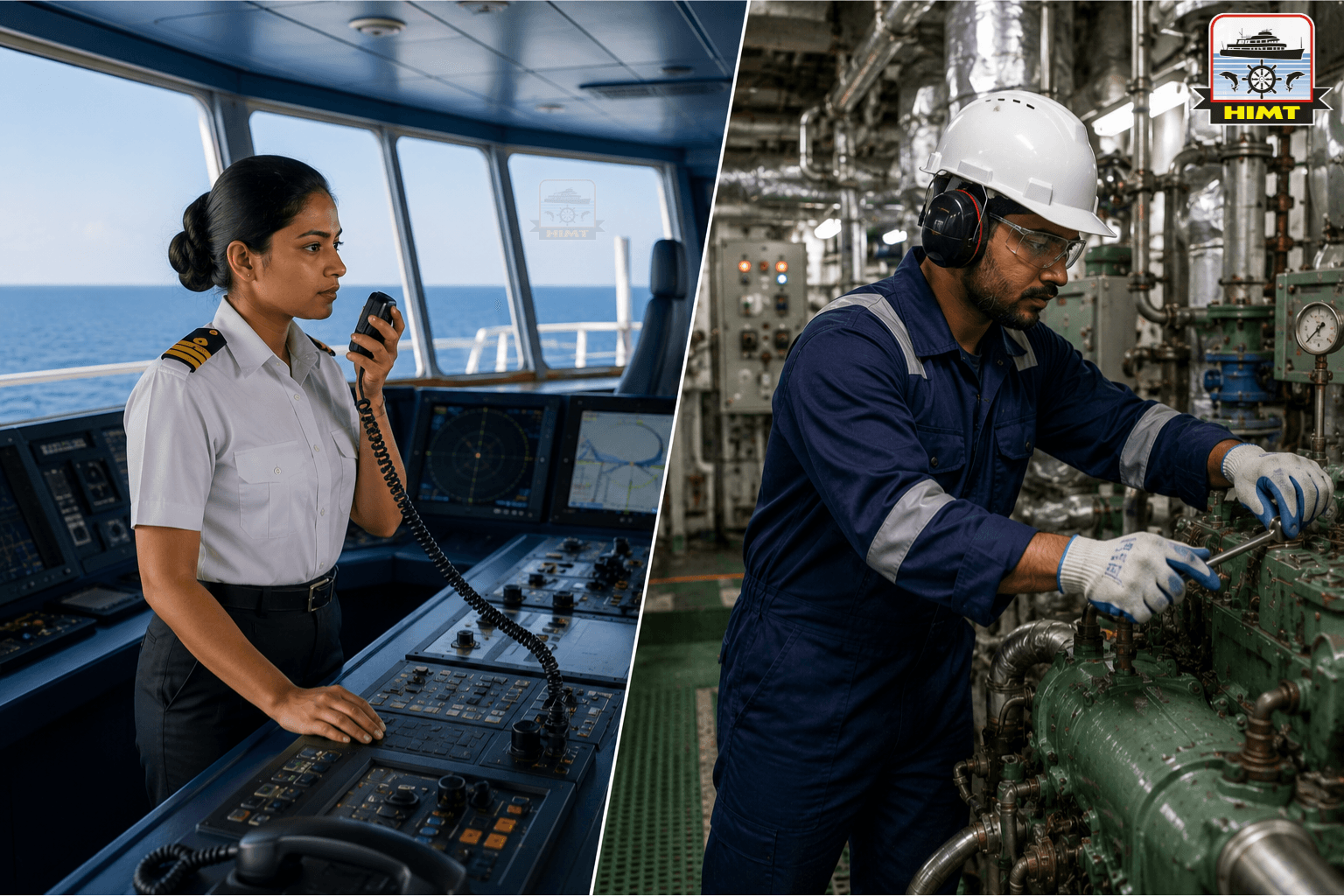
What is the Ship Bridge?
The Ship Bridge, also called the Navigation Bridge, is the command center of the ship. Officers working on the bridge are responsible for navigating the vessel safely from one port to another.Career path: Deck Cadet → Third Officer → Second Officer → Chief Officer → Master Mariner (Captain)
Primary courses: B.Sc. Nautical Science (3 years) or DNS (Diploma in Nautical Science)
What is the Engine Room?
The Engine Room is the mechanical heart of the ship. Marine engineers are responsible for operating, maintaining, and repairing all machinery systems including main propulsion engines, generators, pumps, compressors, electrical systems, and fuel systems.Career path: Trainee Marine Engineer → Fourth Engineer → Third Engineer → Second Engineer → Chief Engineer
Primary course: B.Tech Marine Engineering (4 years) or GME for engineering graduates
Key Differences
Work environment: Bridge officers work in a cleaner, climate-controlled environment, while engine room engineers work in a noisier, hotter environment dealing with heavy machinery.
Skills required: Deck officers need strong navigation, communication, and leadership skills. Marine engineers need mechanical aptitude and technical problem-solving skills.
Salary comparison: A Captain (Deck) can earn ₹8–15 lakh/month, while a Chief Engineer (Engine) can earn ₹7–12 lakh/month.