HIMT Receives IMF Award 2026 — International Maritime Federation
If you are planning to join the Merchant Navy or are preparing for maritime entrance exams such as IMU CET, one of the first subjects you should learn is General Ship Knowledge (GSK). Understanding the basic parts of a ship, its departments, equipment, safety systems, and common maritime terms helps students build a strong foundation before starting practical training.
Whether you are interested in becoming a Deck Officer, Marine Engineer, Electro-Technical Officer (ETO), or GP Rating, learning general ship knowledge is essential. This guide explains the fundamentals, making it easy for beginners to understand.
What is General Ship Knowledge?
General Ship Knowledge (GSK) refers to the basic understanding of a ship’s structure, equipment, operations, safety procedures, and maritime terminology. It helps seafarers understand how a ship is built, how it operates, and how different departments work together to ensure safe and efficient voyages.
Every maritime student should know:
- Ship parts
- Ship types
- Ship departments
- Navigation basics
- Safety equipment
- Shipboard communication
- Pollution prevention
- Cargo handling basics
These concepts are commonly asked in maritime entrance examinations and interviews.
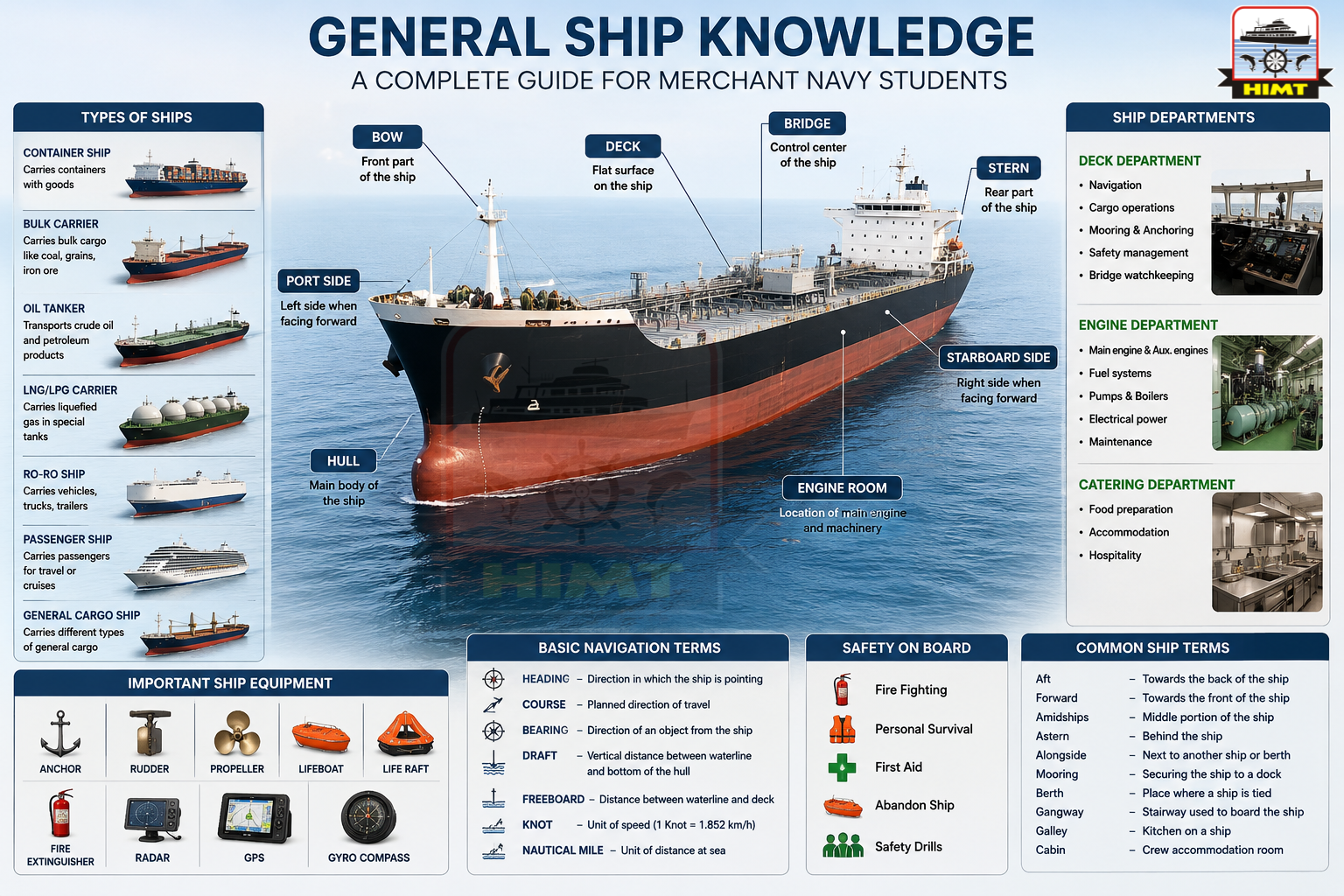
Main Parts of a Ship
Understanding the major parts of a ship is the first step in maritime education.
Bow
The Bow is the front part of the ship. It is designed to cut through the water efficiently, reducing resistance.
Stern
The Stern is the rear part of the ship. The propeller and rudder are usually located here.
Port Side
When facing the bow, the left side of the ship is called the Port Side.
Starboard Side
When facing the bow, the right side is called the Starboard Side.
Hull
The Hull is the main body of the ship that floats on water and provides structural strength.
Deck
The Deck is the flat surface where crew members walk and cargo operations take place.
Bridge
The Bridge is the ship’s control centre where navigation and steering are managed by the deck officers.
Engine Room
The Engine Room contains the main engine, generators, pumps, boilers, and other machinery required for propulsion and power generation.
Types of Ships
Merchant ships are designed for different purposes depending on the cargo they carry.
Container Ship
Used to transport containers carrying manufactured goods worldwide.
Bulk Carrier
Carries unpackaged bulk cargo such as coal, iron ore, grains, and cement.
Oil Tanker
Transports crude oil, petroleum products, and chemicals.
LNG and LPG Carrier
Specially designed ships used to transport Liquefied Natural Gas (LNG) and Liquefied Petroleum Gas (LPG).
Passenger Ship
Carries passengers between ports or on cruise vacations.
Ro-Ro Ship
Roll-on/Roll-off ships transport vehicles such as cars, trucks, and trailers.
General Cargo Ship
Carries different types of cargo that are not transported in containers.
Departments on a Ship
Every merchant ship has different departments responsible for specific operations.